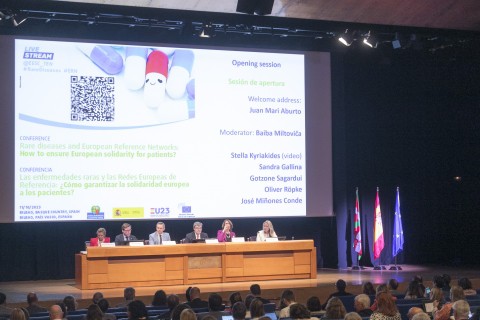
From 9th to 11th October the project managers meeting and a conference on rare diseases and ERNs was held in Bilbao, Spain. The meeting consisted of the presentation of activities done by all the 24 ERNs. The conference on Rare diseases and European reference networks was organised under the auspices of the Spanish Presidency of the EU Council and in cooperation with the authorities of the Basque Country. It took place on 11 October 2023 in the Euskalduna Conference Centre in Bilbao, Spain. High-level speakers from European Commission, Ministry of Health of Basque government and also Spain , EESC and Mayor of Bilbao attended the meeting on rare diseases. The conference aims at reviewing the state of play and to address some of the main challenges facing the EU policy framework on rare diseases and European Reference Networks.
Four main challenges were addressed:
● Strengthening and integrating ERNs and national networks of highly specialised
providers: what has been learned from the five-yearly evaluation of the ERNs and what
is planned for the Joint Action on integration of ERNs;
● Integrating social and health care for patients with rare diseases: the burden on families
and unmet social and health care needs;
● Research priorities and resources: what is not covered? The opportunity offered by the
European Health Data Space Regulation;
● Affordability and development of new treatments and therapies: how to improve access
to safer, more effective medicines while ensuring that they are affordable and healthcare
systems are sustainable.
Conclusions and recommendations of the conference on Rare Diseases and European Reference Networks “How to ensure European solidarity for patients?” are now available here.