Joint Transnational Call 2023
The content and procedures of the call described in this pre-announcement may be subject to change and are not legally binding.
The European Joint Programme on Rare Diseases (EJP RD) has successfully implemented four Joint Transnational Calls since 2019 to further help in coordinating the research efforts of European, Associated and non-European countries in the field of rare diseases and implement the objectives of the International Rare Disease Research Consortium (IRDiRC). These actions are following the ten Joint Transnational Calls for rare diseases research projects launched previously by the ERA-Net E-Rare since 2006.
A number of national and regional funding organisations will participate in the EJP RD Joint Transnational Call (JTC) 2023 and will fund multilateral research projects on rare diseases. Final decision on participating funding agencies will be issued before the launch of the call. The call is expected to be opened simultaneously by the following funding organisations in their respective countries/regions:
- Austrian Science Fund (FWF), Austria*
- Fund for Scientific Research – FNRS (F.R.S.-FNRS), Belgium, French-speaking community
- Canadian Institutes of Health Research – Institute of Genetics (CIHR-IG), Canada
- French National Research Agency (ANR), France
- German Ministry of Education and Research (BMBF), Germany
- German Research Foundation (DFG), Germany
- National Research, Development and Innovation Office (NKFIH), Hungary*
- Health Research Board (HRB), Ireland
- Chief Scientist Office of the Ministry of Health (CSO-MOH), Israel
- Italian Ministry of Health (IT-MoH), Italy
- Regional Foundation for Biomedical Research (FRRB), Lombardy (Italy)
- Tuscany Region (RT/TuscReg), Tuscany (Italy)
- Fondazione Telethon, Italy
- Research Council of Lithuania (LMT), Lithuania
- National Research Fund (FNR), Luxembourg
- National Centre for Research and Development (NCBR), Poland
- Slovak Academy of Sciences (SAS), Slovakia
- National Institute of Health Carlos III (ISCIII), Spain
- Swedish Research Council (SRC), Sweden
- Vinnova, Sweden*
- Swiss National Science Foundation (SNSF), Switzerland
- The Scientific and Technological Research Council of Türkiye (TUBITAK), Türkiye*
*Decision is still pending for JTC2023
The aim of the call is to enable scientists in different countries to build an effective collaboration on a common interdisciplinary research project based on complementarities and sharing of expertise, with expected impact to use the results in the future for benefit of patients.
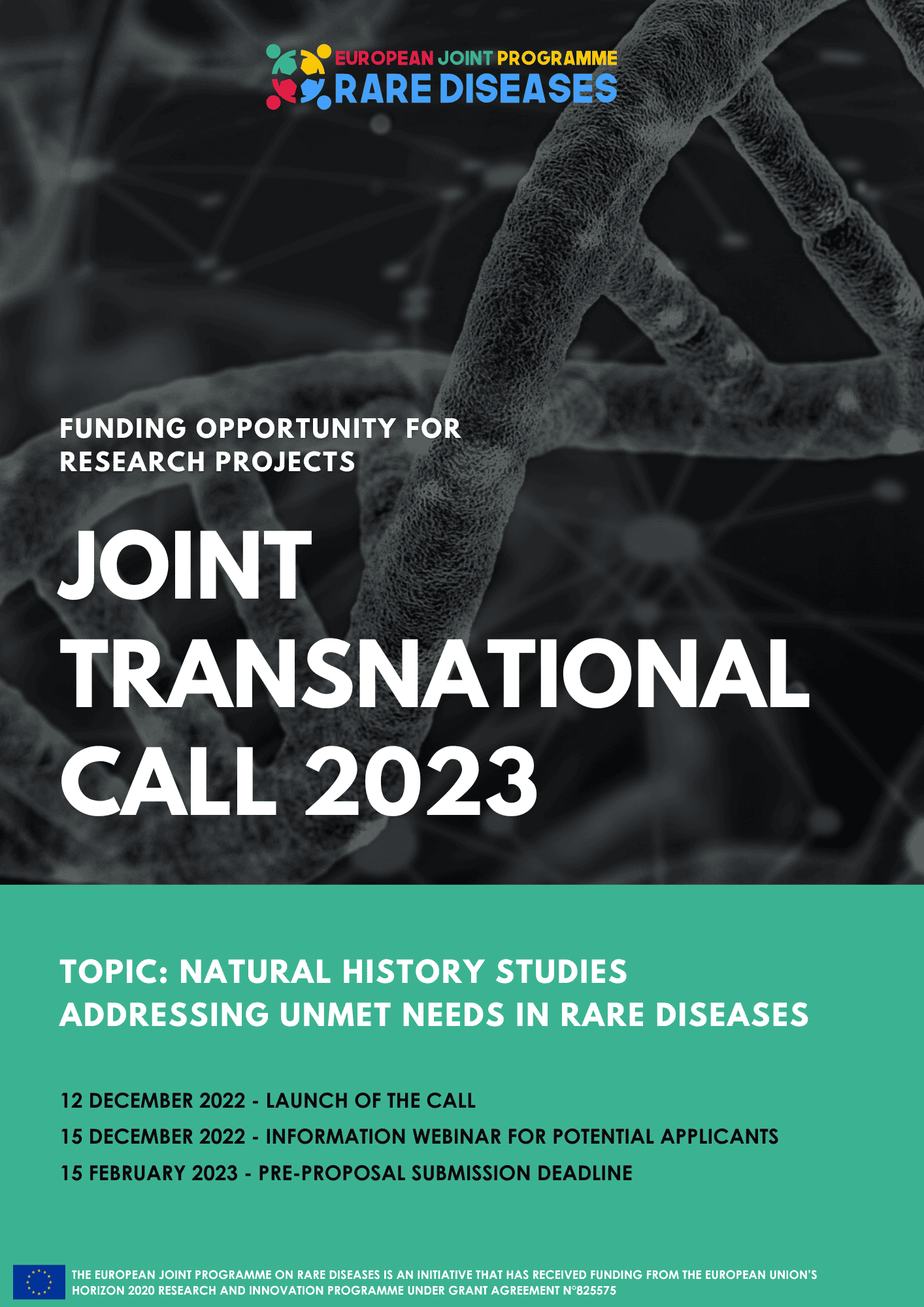
Topic: Natural History studies addressing unmet needs in Rare Diseases
The objective of this call is to conduct efficient, innovative and high-quality natural history studies which will facilitate understanding of the disease’s or group of disorders’ progression throughout the lifespan of a patient. The goal of these studies is to collect and analyze comprehensive patient data to define targets for future therapies, taking into consideration innovation, safety, and efficacy.
Research proposals should cover at least one of the following areas:
- Estimation of disease prevalence;
- Identification of biomarkers/companions for the diagnosis/prognosis of a RD;
- Identification of biomarkers/indicators/predictors of a rare disease or group of disorders (e.g. having the same aetiology) onset/progression (including collection of genetic, physiological, environmental data or variables….);
- Identification of relevant endpoints for future studies that include potential biomarkers, querying patient-reported outcomes (PROs) and quality-of-life measures to identify the most;
- Identification of biomarkers/variables for therapeutic approaches (pharmacology, drug repurposing, gene therapy, RNA therapy, cell therapy, medical devices…).
It is possible to use cellular and animal models for validation of the new diagnostic approaches in the subtopics listed above where relevant.
Furthermore, additional elements need to be considered in the application:
- Inclusion of patient and caregiver perspectives from the RD community is strongly encouraged. Patients living with a RD or a family member who cares for them, have experiences and knowledge that can contribute to generating data about the natural progression of the disease. Patients should be involved in all steps of planning and implementation of the study;
- For the small group of well-characterized rare diseases with approved treatments or improved standard of care, prospective studies can define the altered disease progression under the current medical setting. Thereby, studies collecting data regarding adverse events and providing reference/data for development of a more effective or safer treatment can be considered for complementing the natural history study.
The following approaches and topics are excluded from the scope of the call JTC2023:
- Interventional clinical trials to prove efficacy of drugs, treatments, surgical procedures, medical procedures. This also includes studies comparing efficacy, e.g. two surgical techniques or therapies. Projects whose main objective is the implementation of a clinical phase IV pharmacovigilance study cannot be funded either.
- Studies on the exclusive testing of the safety of medical devices and drugs.
- Development of new therapies as covered in EJP RD JTC 2020.
- Development of new analytic tools and pathways to accelerate diagnosis and facilitate diagnostic monitoring of rare diseases as covered in EJP RD JTC 2022.
- Projects focusing only on rare neurodegenerative diseases which are within the main focus of the Joint Programming Initiative on Neurodegenerative Disease Research (JPND). These are: Alzheimer’s disease and other dementias; Parkinson’s disease (PD) and PD-related disorders; Prion diseases; Motor Neuron Diseases; Huntington’s disease; Spinal Muscular Atrophy and dominant forms of Spinocerebellar Ataxia. Interested researchers should refer to the relevant JPND calls. However, childhood dementias/neurodegenerative diseases are not excluded.
- Rare infectious diseases, rare cancers and rare adverse drug events in treatments of common diseases. Rare diseases with a predisposition to cancer are not excluded.